| - | - | - |
|---|---|---|
| Product Group | : | Antibacterials |
| Pharmaceutical Form | : | Suspension for Injection |
| Active Ingredient | : | Ceftiofur Hydrochloride |
| Target Species | : | Cattle |
| Package Form | : | 100 - 250 ml |
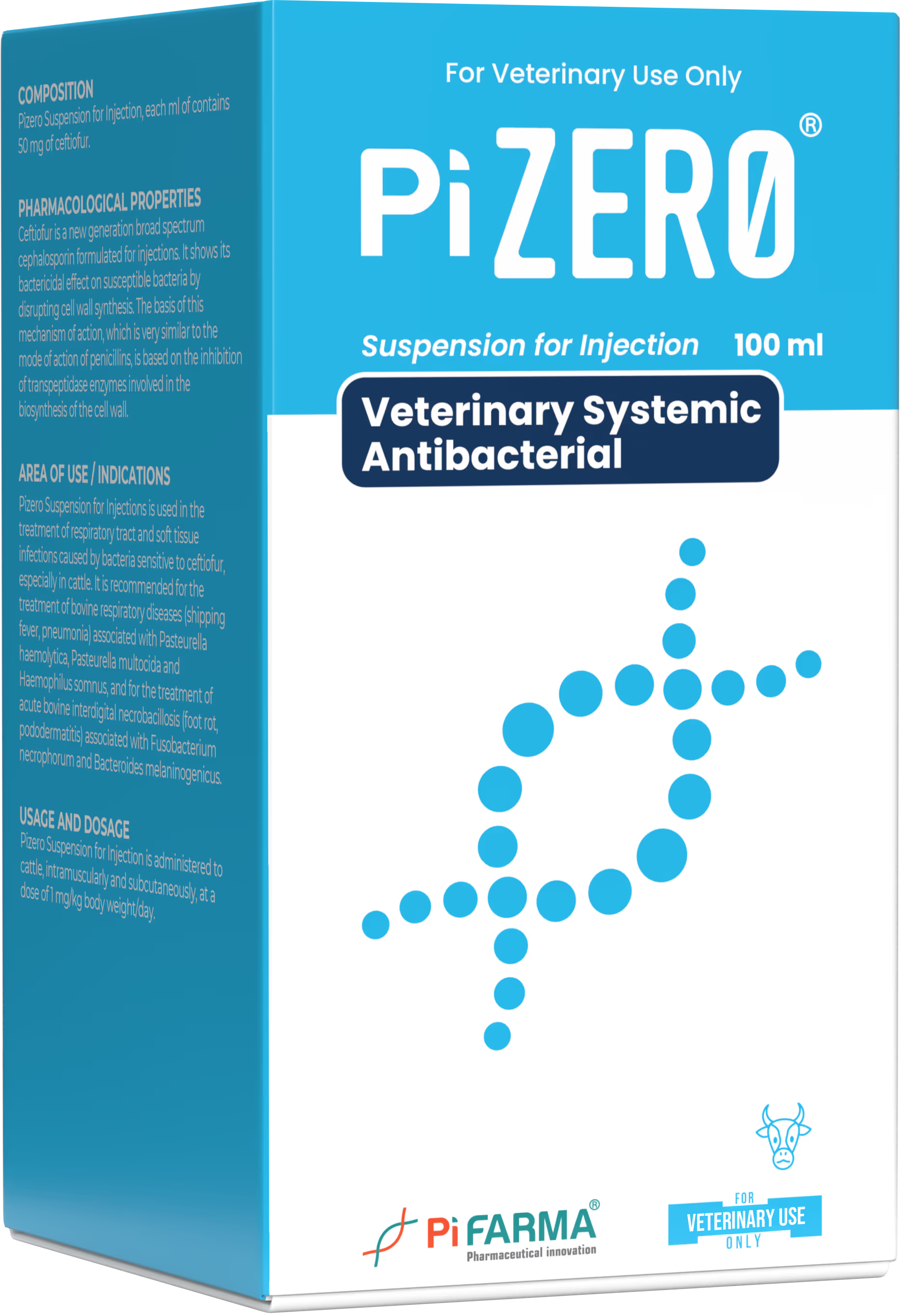
For Veterinary Use Only
For Veterinary Use Only
Suspension for Injection
Veterinary Systemic Antibacterial
COMPOSITION
Pizero is a white – pale yellow colored sterile suspension containing ceftiofur hydrochloride equivalent to 50 mg ceftiofur per ml.
PHARMACOLOGICAL PROPERTIES
Pharmacodynamic Properties
Ceftiofur is a 3. Generation cephalosporin, effective against most Gram positive and Gram negative bacteria. Ceftiofur, acts by inhibiting bacterial cell wall synthesis.
Betalactams act by interfering with bacterial cell wall synthesis. Cell wall synthesis is dependent on enzymes called penicillin binding proteins. Bacteria develop resistance to cephalosporins by 4 basic mechanisms; 1) By desensitizing penicillin-binding proteins, 2) By changing the permeability of the cell wall to beta-lactam, 3) By producing beta-lactamase, which cleaves the beta-lactam ring, 4) Active efflux.
Some beta-lactamases found in gram-negative enteric organisms can variably elevate MICs of first- and second-generation cephalosporins, beta-lactam-inhibiting combinations, penicillins, ampicillins, and third- and fourth-generation cephalosporins.
The MIC values of the target bacteria obtained from infected animals in Europe are as follows:
|
Bacteria (izolate count) |
MIC range (µg/mL) |
MIC90 (µg/mL) |
|
Mannheimia haemolytica (149) |
£ 0.002 - 0.12 |
0.015 |
|
Pasteurella.multocida (134) |
£ 0.002 - 0.015 |
0.004 |
|
Histophilus somni (66) |
£ 0.002 - 0.008 |
0.004 |
|
Truperella pyogenes (35) |
0.25 - 4 |
2 |
|
Escherichia coli (209) |
0.13 - 2 |
0.5 |
|
Fusobacterium necrophorum (67) (Foot rot izolatları) |
£ 0.06 - 0.13 |
ND |
|
Fusobacterium necrophorum (2) (akut metrit izolatları) |
£ 0.03 - 0.06 |
ND |
ND: Not Detected.
The Clinical and Laboratory Institute has recommended the following values for respiratory pathogens on the label for ceftiofur.
|
Zone Radius (mm) |
MIC (μg/mL) |
Evaluation |
|
≥ 21 |
£ 2.0 |
(S) Susceptible |
|
18 - 20 |
4.0 |
(I) Intermediate |
|
£ 17 |
≥ 8.0 |
(R) Resistant |
Pharmacokinetics Properties
After administration, ceftiofur is rapidly metabolized to its main metabolite, desfuroilceftiofur.
This metabolite has antimicrobial activity equivalent to ceftiofur. It binds alternately to plasma proteins. Due to its binding to these proteins, the metabolite is actively involved at the site of infection and remains active in the presence of pus and nectoric tissue.
At a single dose of 1 mg/kg subcutaneous administration in cattle, the maximum plasma level (2.85 ± 1.11 µg/mL) was reached two hours after administration. In healthy cattle, the Cmax level in the enrometrium was measured as 2.25 ± 0.79 µg/mL after 5±2 hours in a single application. Maximum concentrations in the carncula and lochia were measured as 1.11 ± 0.24 µg/mL and 0.98 ± 0.25 µg/mL, respectively.
Half life in cattle is 11.5 ± 2.57 hours. No accumulation was observed with daily treatments longer than five days. Excretion is mainly in the urine (more than 55%) and feces (31%).
The bioavailability of ceftiofur is complete after subcutaneous administration..
AREA OF USE/INDICATIONS
Susceptible to ceftiofur in cattle;
- Treatment of respiratory system infections caused by Mannheimia haemolytica old name is Pasteurella haemolytica), Pasteurella multocida and Histophilus somni (old name is Haemophilus somnus),
- Treatment of acute interdigital necrobacillosis (panarisium, foot root) caused by Fusobacterium necrophorum and Bacteroides melaninogenicus (Porphyromonas asaccharolytica),
- Treatment of acute post-partum (puerperal) metritis caused by Escherichia coli, Arcanobacterium pyogenes and Fusobacterium necrophorum within 10 days of birth where treatment with other antibiotics has failed.
USAGE AND DOSAGE
Shake the bottle strongly before use, not more than 60 seconds or until it is sufficiently suspended.
For an accurate dosing, the body weights of the animals should be measured as accurately as possible.
Respiratory System Infections: 1 mg/kg body weight (1 ml product for 50 kg body weight), subcutaneously, for 3-5 days.
Acute interdigital necrobacillosis: 1 mg/kg body weight (1 ml product for 50 kg body weight), subcutaneously, for 3 days.
Acute post-partum metritis (within 10 days after birth): 1 mg/kg body weight (1 ml product for 50 kg body weight), subcutaneously, for 5 days. In some cases, supportive treatment may be required in this infection. Maximum of 15 ml should be injected on injection site. Injections on different days should be given to different areas.
SPECIAL CLINICAL INFORMATION AND SPECIAL WARNINGS FOR TARGET SPECIES
Shake well before using.
If an allergic reaction is observed, treatment should be discontinued.
This product is selective for resistant strains producing extended-spectrum beta-lactamases that may pose a risk to human health (eg via food). Therefore, this product should be reserved as a reserve antibiotic for conditions where initial therapy is poor or expected to result (severe acute conditions in which therapy must be initiated without a bacteriological diagnosis).
Regional and national antimicrobial policies should be considered in the use of this product.
Increased use of this product, including use other than as described in this document, may result in an increased prevalence of resistant bacteria. For this reason, the product should be used according to the results of the susceptibility test as much as possible.
Do not use as preventive purposes in case of the retention of the placenta. This product is for individual treatment. It is not used as part of disease prevention or herd health programs. Group treatment of animals should be limited to epidemics only, in accordance with approved terms of use.
Use during pregnancy and lactation: Although studies in laboratory animals have not shown effects on teratogenicity, abortion and reproduction, the safe use of the product in pregnant cows has not been studied. It can only be used during pregnancy according to the benefit/risk assessment of the veterinarian.
UNDESIRED EFFECTS
Dose-independent hypersensitivity reactions may occur. Allergic reactions (e.g. skin reactions, anaphylaxis) have been reported very rarely (less than 1 in 10000 animals). After subcutaneous administration in cattle, swelling and hardness were observed at the application site. Up to 42 days after injection, mild to moderate local tissue reactions (edema, discoloration, etc.) were observed. According to field reports, injection site reactions are very rare.
DRUG INTERACTIONS
The bactericidal action of beta-lactams is inhibited by bacteriostatic antibiotics such as macrolides, sulfonamides and tetracyclines. Aminoglycosides positively affect the action of cephalosporins. It should not be mixed with other products in the absence of compatibility studies.
SYMPTHOMS OF OVERDOSE, PRECAUTIONS AND ANTIDOTE
There was no significant indication of systemic toxicity in parenteral overdose in cattle.
WITHDRAWAL PERIODS
Cattle; Meat: 8 days, Milk: 0 day
CONTRAINDICATIONS
Do not use for animals known to be sensitive to ceftiofur or beta-lactams.
Do not administer intravenously.
It is not used in cases of resistance to other cephalosporins or beta-lactams.
It is not used in chickens, including layers, due to the risk of antimicrobial resistance to humans.
GENERAL WARNINGS
Consult your Veterinary Surgeon before use and in case of unexpected effect is observed. Keep out of reach of children and foodstuffs.
PRECAUTIONS TO BE TAKEN BY THE ADMINISTRATOR AND WARNINGS FOR VETERINARY SURGEON
Penicillin and cephalosporins may cause hypersensitivity (allergy) reactions after injection, inhalation, ingestion or skin contact. Sensitivity to penicillins causes sensitivity to cephalosporins (or opposite). Rarely, these reactions can be very serious.
If you are sensitive and have received medical advice not to work with such products, do not touch this product.
If symptoms such as skin rash develop, seek medical treatment immediately and show this warning to the healthcare professional. Take the necessary precautions not to accidentally inject the product into yourself. In such a case, immediately apply to a health institution.
Symptoms such as swelling of the face, lips or eyes or difficulty breathing are very serious and require immediate medical attention. Wash your hands after use.
STORAGE CONDITIONS AND SHELF LIFE
Store below 25oC, in the original package not frozen or placed in the refrigerator. Shelf life 2 years. After opening, it should be consumed within 28 days. The stopper should not be punctured more than 14 times for 100 ml products or more than 30 times for 250 ml products.
DISPOSAL AFTER USING AND WARNINGS FOR NON-TARGET SPECIES
The product used or remaining should be disposed in accordance with the relevant legislation.
COMMERCIAL PRESENTATION FORM
It is sold in cardboard boxes containing 100 ml and 250 ml transparent Type II glass vials with grey bromobutyl rubber stoppers and flip-off transparent caps.
PLACE AND CONDITIONS OF SALE
Sold with Veterinary Surgeon’s prescription in pharmacies and veterinary surgeries. (VSP)
APPROVAL DATE OF THE LEAFLET: 21.11.2025
MARKETING AUTHORIZATION DATE AND NO: 13.12.2011-025/0019
MARKETING AUTHORIZATION HOLDER
Pİ FARMA İLAÇ SAN. VE TİC. A.Ş.
MANUFACTURER COMPANY
FDN İLAÇ SAN. VE TİC. LTD. ŞTİ.
Büyükkayacık OSB Mah. İnsu Sokak No:3 Selçuklu/Konya-Türkiye
Made in Turkiye