| - | - | - |
|---|---|---|
| Product Group | : | Antibacterials |
| Pharmaceutical Form | : | Solution for Injection |
| Active Ingredient | : | Enrofloxacin |
| Target Species | : | Cattle, Sheep, Goat |
| Package Form | : | 50 - 100 - 250 ml |
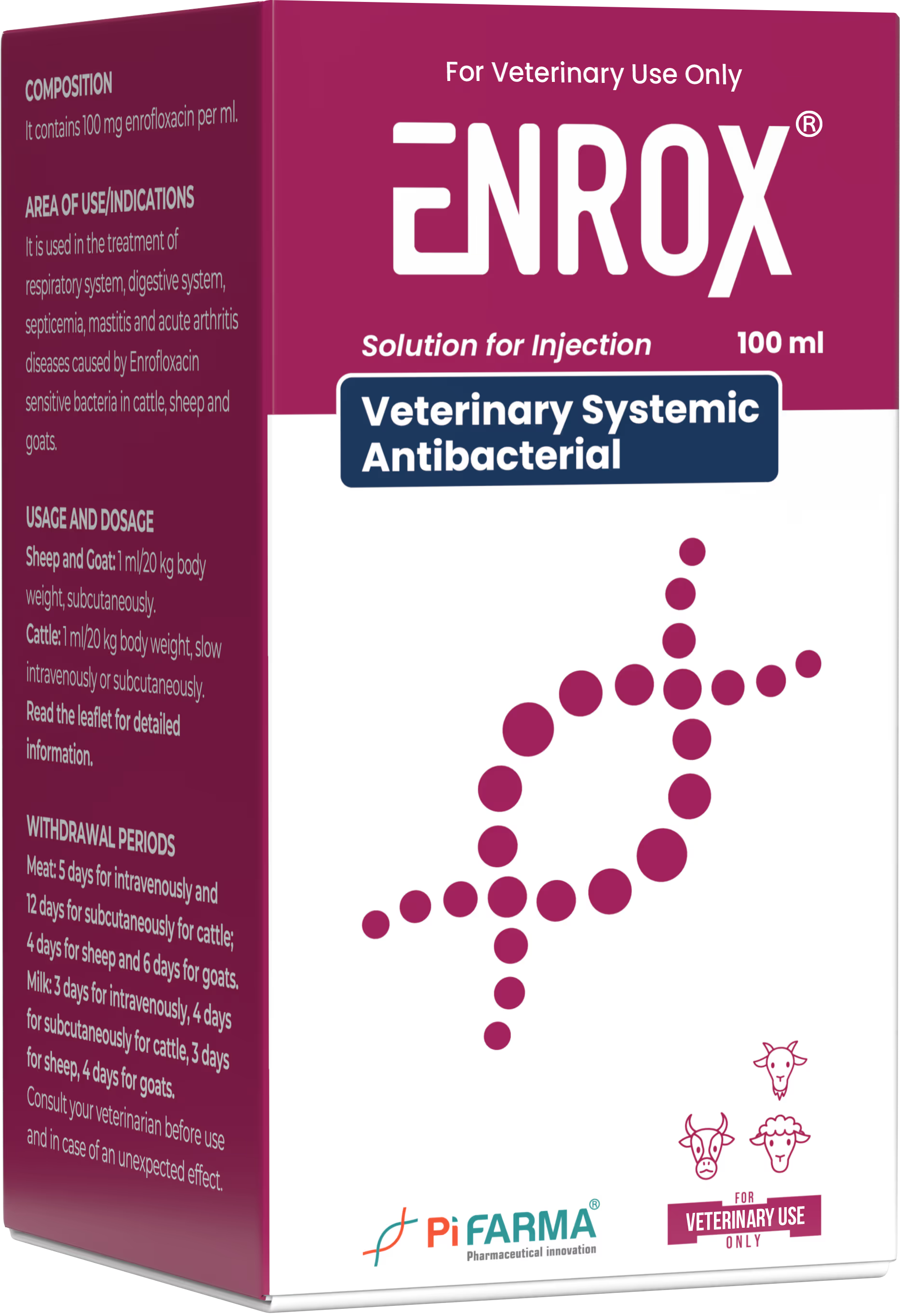
For Veterinary Use Only
For Veterinary Use Only
Solution for Injection
Veterinary Systemic Antibacterial
COMPOSITION
Enrox Solution for Injection; is a light yellow, clear solution containing 100 mg enrofloxacin per ml.
PHARMACOLOGICAL PROPERTIES
Pharmacodynamic Properties
Mode of action: Two essential enzymes involved in DNA replication and transcription have been identified as molecular targets of fluoroquinolones; DNA-gyrase and topoisomerase. Inhibition of the target occurs by non-covalent binding of fluoroquinolones to these enzymes. Replication forks and translation complexes can’t go beyond the enzyme-DNA-fluoroquinolone complex, and inhibition of DNA and mRNA triggers rapid concentration-dependent death of pathogenic bacteria. The activity of enrofloxacin is bactericidal and this effect is dose dependent.
Antibacterial spectrum: Enrofloxacin is effective against most Gram-negative bacteria such as Escherichia coli, Klebsiella spp., Actinobacillus pleuropneumoniae, Mannheimia haemolytica, Pasteurella spp. (eg: Pasteurella multocida), Gram-positive bacteria such as Staphylococcus spp. (eg Staphylococcus aureus) and Mycoplasma spp. in therapeutic dose.
Resistance mechanism and types: Five sources of resistance to fluoroquinolones have been reported:
- Point mutation in the coding of these enzymes, causing a change in DNA gyrase and/or topoisomerase IV enzymes,
- Change in permeability in Gram-negative bacteria,
- Efflux mechanism,
- Gyrase protective proteins,
- Plasmid-mediated resistance.
All mechanisms result in decreased susceptibility of bacteria to fluoroquinolones.
Cross-resistance is common among fluoroquinolones.
Pharmacokinetic Properties
Enrofloxacin is rapidly absorbed after parenteral administration. Its bioavailability is high (approximately 100% in calves). It is approximately 20-50% bound to plasma proteins. Enrofloxacin is metabolized to the active metabolite, ciprofloxacin, at a rate of 40% in dogs and ruminants, and less than 10% in cats.
Enrofloxacin is distributed to target tissues such as lung, kidney and liver 2-3 times as much as plasma. Enrofloxacin is also distributed into the cerebrospinal fluid, fetal and ocular fluid in pregnant animals. The parent compound and its active metabolite are excreted by the kidneys and feces.
AREA OF USE/INDICATIONS
Cattle
Treatment of respiratory system infections caused by enrofloxacin susceptible Pasteurella multocida, Mannheimia haemolytica and Mycoplasma spp. strains, treatment of acute severe mastitis caused by Escherichia coli strains, treatment of digestive system infections caused by Escherichia coli strains, treatment of septicemia caused by Escherichia coli strains, treatment of Mycoplasma-associated acute arthritis caused by Mycoplasma bovis strains in cattle under 2 years of age.
Sheep
Treatment of digestive system infections caused by enrofloxacin susceptible Escherichia coli strains, treatment of septicemia caused by Escherichia coli strains, mastitis treatment caused by Staphylococcus aureus and Escherichia coli.
Goat
Treatment of respiratory system infections caused by enrofloxacin susceptible Pasteurella multocida and Mannheimia haemolytica strains, treatment of digestive system infections caused by Escherichia coli strains, treatment of septicemia caused by Escherichia coli strains, mastitis treatment caused by Staphylococcus aureus and Escherichia coli.
USAGE AND DOSAGE
Make repeated injections at different sites.
Body weight should be calculated as accurately as possible to avoid underdosing.
Cattle
It is administered at a dose of 5 mg/kg body weight/day (1 ml/20 kg body weight) once a day for 3-5 days. It is applied for 5 days in acute arthritis caused by Mycoplasma in cattle under 2 years of age.
It is administered by slow intravenous or subcutaneous route.
In acute mastitis caused by Escherichia coli, a slow intravenous dose of 5 mg/kg body weight/day (1 ml/20 kg body weight) is administered once a day for two days. The second dose can be administered subcutaneously. In this case, the residual time is determined by subcutaneous administration.
Do not apply more than 10 ml to an injection site.
Sheep – Goat
It is administered subcutaneously at a dose of 5 mg/kg body weight/day (1 ml/20 kg body weight) once a day for 3 days.
Do not apply more than 6 ml to an injection site.
SPECIAL CLINICAL INFORMATION AND SPECIAL WARNINGS FOR TARGET SPECIES
It is not used for prophylaxis.
Do not exceed the recommended dose.
Make repeated injections at different sites.
Degenerative changes in the articular cartilages were observed in calves administered orally at a dose of 30 mg/kg body weight for 14 days.
Administration at recommended dose for 15 days in growing lambs causes histological changes in the articular cartilages that do not show clinical signs.
In practice, national and regional antimicrobial policies should be considered.
Failure to use this product in accordance with the instructions outlined in the summary of product characteristics may result in the growth of bacteria resistant to fluoroquinolones and reduced efficacy of other quinolones due to possible cross-resistance.
Fluoroquinolones should be used as a reserve for the treatment of clinical conditions that are poorly responsive or expected to respond to other antibiotics.
Use this product according to the results of susceptibility tests for bacteria obtained from animals.
If an allergic reaction occurs, treatment should be discontinued.
Since enrofloxacin is partially excreted by the kidneys, it should be considered that enrofloxacin is excreted slowly from renal dysfunction.
Since the safety of intravenous use of this product in calves has not been proven, it should not be used in this way.
Use in pregnancy and lactation: Cattle: This product can be used in the first quarter of pregnancy. However, its use in the last 3 quarters of pregnancy depends on the benefit/risk assessment of the veterinarian. There is no harm in using the product during the lactation period.
Sheep – Goat: The safety of the use of this product during pregnancy and lactation has not been studied. Therefore, it should be used depending on the benefit/risk assessment of the veterinarian.
UNDESIRED EFFECTS
Local tissue reactions may rarely occur at the injection site. Very rarely, digestive system disorders (such as diarrhea) can be seen. These symptoms are usually mild and temporary.
Very rarely, intravenous administration in cattle may result as a shock reaction.
The following translation is used to report the frequency of side effects.
- very common (more than 1 in 10 animals treated)
- common (more than 1 but less than 10 animals in 100 animals treated)
- uncommon (more than 1 but less than 10 animals in 1,000 animals treated)
- rare (more than 1 but less than 10 animals in 10,000 animals treated)
- very rare (less than 1 animal in 10,000 animals treated).
DRUG INTERACTIONS
Concomitant administration of enrofloxacin with antibiotics such as tetracyclines, phenicols and macrolides produces an antagonistic effect.
Enrofloxacin should not be co-administered with theophylline as it slows the excretion of theophylline.
SYMPTOMS OF OVERDOSE, PRECAUTIONS AND ANTIDOTE
Do not exceed the recommended dose. There is no antidote in overdose, symptomatic treatment should be done.
There are no studies of overdose in calves, sheep and goats.
As a result of accidental overdose, digestive system disorders such as vomiting and diarrhea and nervous disorders may occur.
Overdose may cause dysfunction of the central nervous system and kidneys.
WITHDRAWAL PERIODS
Meat: 5 days for intravenously and 12 days for subcutaneously for cattle; 4 days for sheep and 6 days for goats.
Milk: 3 days for intravenously, 4 days for subcutaneously for cattle, 3 days for sheep, 4 days for goats.
CONTRAINDICATIONS
It is not used for protection (prophylaxis) purposes. Do not use in situations where resistance to other fluoroquinolones exists due to possible cross-resistance. It should not be used in animals with hypersensitivity to any of the ingredients of the product. Because enrofloxacin stimulates the central nervous system, it should be used with caution in animals with epilepsy or a history of seizures. It should not be used in growing horses due to possible significant damage to articular cartilage.
GENERAL WARNINGS
Consult your veterinarian before use and in case of an unexpected effect. Keep out of reach of children and foodstuffs.
PRECAUTIONS TO BE TAKEN BY THE ADMINISTRATOR AND WARNINGS FOR VETERINARY SURGEON
This product is alkaline. In case of contact with skin or eyes, rinse with plenty of water. Do not eat, drink or smoke while using the product. People sensitive to fluoroquinolones should avoid contact with the product. In case of accidental self-injection, seek immediate medical treatment and show the product leaflet and label to your doctor. Wash your hands after use. Use impermeable gloves during product contact and application.
STORAGE CONDITIONS AND SHELF LIFE
It should be stored under 25°C in the original package, without being frozen or placed in the refrigerator. Shelf life is 2 years.
COMMERCIAL PRESENTATION FORM
Offered for sale in 50 ml, 100 ml and 250 ml amber colored glass vials with cardboard boxes.
PLACE AND CONDITIONS OF SALE
Sold with Veterinary Surgeon’s prescription in pharmacies, veterinary clinics, polyclinics and animal hospitals (VSP).
APPROVAL DATE OF THE PACKGAGE INSERT: 05.06.2023
MARKETING AUTHORIZATION DATE AND NO: 06.12.2006 – 017/0036
MARKETING AUTHORIZATION HOLDER
Pİ FARMA İLAÇ SAN. VE TİC. A.Ş.
Malıköy Başkent OSB Mah. 26. Cad. No:34/A Sincan/Ankara-Türkiye
MANUFACTURER COMPANY
1- Pİ FARMA İLAÇ SAN. VE TİC. A.Ş.
Malıköy Başkent OSB Mah. 26. Cad. No:34/A Sincan/Ankara-Türkiye
2- FDN İLAÇ SAN. VE TİC. LTD. ŞTİ.
Büyükkayacık OSB Mah. İnsu Sokak No:3 Selçuklu/Konya-Türkiye
Made in Turkiye