| - | - | - |
|---|---|---|
| Product Group | : | Anti-Inflammatory |
| Pharmaceutical Form | : | Solution for Injection |
| Active Ingredient | : | Meloxicam |
| Target Species | : | Cattle, Cat, Dog |
| Package Form | : | 20 - 50 - 100 ml |
For Veterinary Use Only
For Animal Use Only
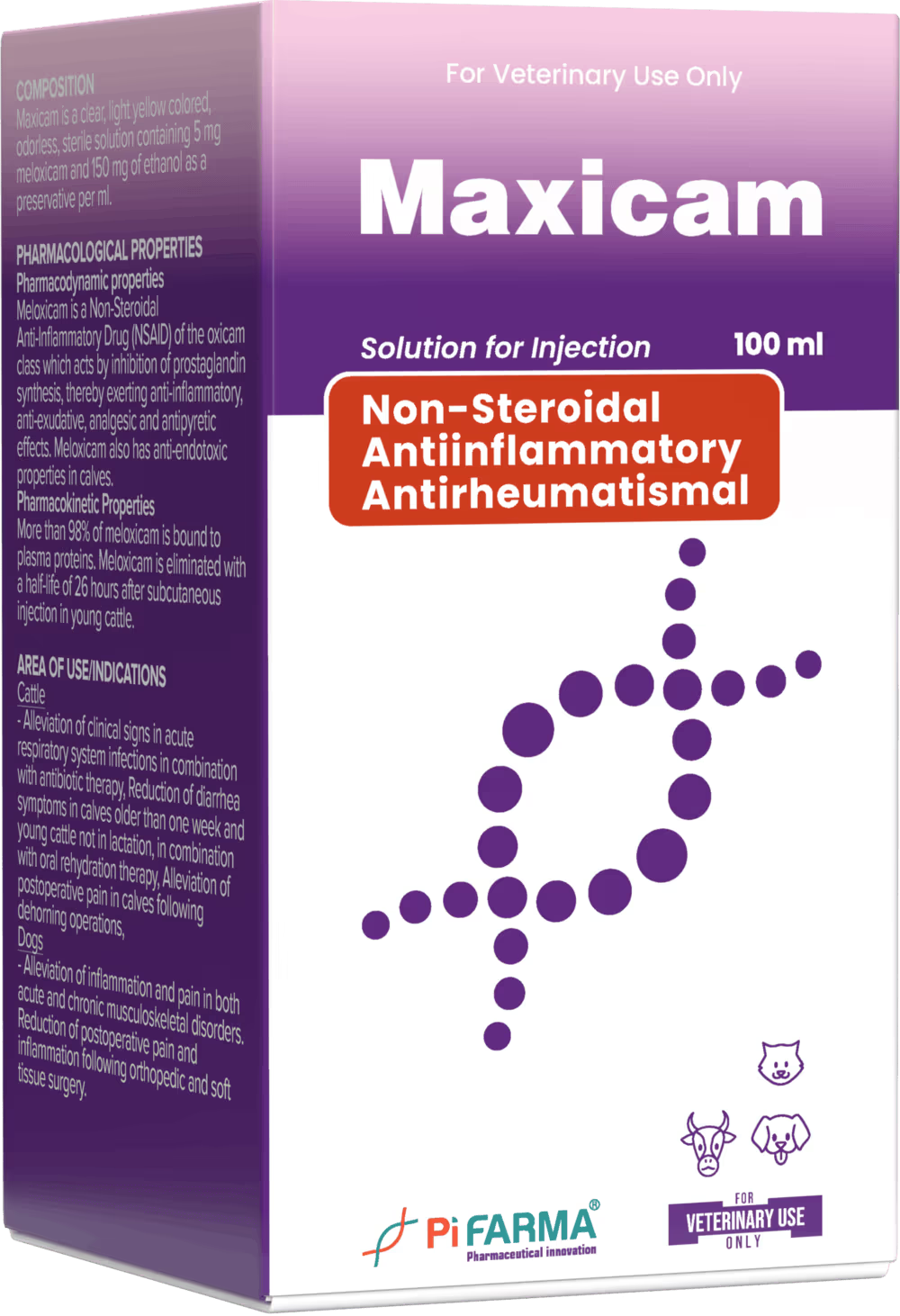
MAXICAM
Solution for Injection
Non-Steroidal, Antiinflamatory, Antirheumatismal
COMPOSITION
Maxicam is a clear, light yellow colored, odorless, sterile solution containing 5 mg meloxicam and 150 mg of ethanol as a preservative per ml.
PHARMACOLOGICAL PROPERTIES
Pharmacodynamic Properties
Meloxicam is a Non-Steroidal Anti-Inflammatory Drug (NSAID) of the oxicam class which acts by inhibition of prostaglandin synthesis, thereby exerting anti-inflammatory, anti-exudative, analgesic and antipyretic effects. Meloxicam also has anti-endotoxic properties because it has been shown to inhibit production of thromboxane B2 induced by E. coli endotoxin administration in calves and pigs.
Pharmacokinetic Properties
Cattle
After a single subcutaneous dose of 0,5 mg meloxicam/kg, Cmax values of 2.1 μg/ml was reached after 7.7 hours in young cattle.
After a single intramuscular dose of 0,4 mg meloxicam/kg, Cmax values of 1,5 and 1,5 μg/ml were reached after an hour in pigs.
More than 98 % of meloxicam is bound to plasma proteins. The highest meloxicam concentrations are to be found in liver and kidney. Comparatively low concentrations are detectable in skeletal muscle and fat.
Meloxicam is predominantly found in plasma. In cattle, meloxicam is also a major excretion product in milk and bile whereas urine contains only traces of the parent compound, whereas urine contains only traces of the parent compound. Meloxicam is metabolised to an alcohol, an acid derivative and to several polar metabolites. All major metabolites have been shown to be pharmacologically inactive.
Meloxicam is eliminated with a half-life of 26 hours after subcutaneous injection in young cattle.
Cat and Dog
Absorption
Following subcutaneous administration, meloxicam is completely bioavailable, reaching maximum mean plasma concentrations of 0.73 µg/ml in dogs and 1.1 µg/ml in cats approximately 2.5 hours and 1.5 hours after administration, respectively.
Distribution
There is a linear relationship between the plasma concentration observed in dogs and cats at the therapeutic dose range and the administered dose. More than 97% of meloxicam binds to plasma proteins. The volume of distribution is 0.3 l/kg in dogs and 0.09 l/kg in cats.
Metabolism
In dogs, meloxicam is predominantly found in plasma and is also a major bile excretion product, whereas urine contains only traces of the parent compound. Meloxicam is metabolized to an alcohol, an acid derivative, and various polar metabolites. All major metabolites have been shown to be pharmacologically inactive.
In cats, meloxicam is predominantly found in plasma and is also a major bile excretion product, whereas urine contains only trace amounts of the parent compound. All five major metabolites have been shown to be pharmacologically inactive. Meloxicam is metabolized to an alcohol, an acid derivative, and various polar metabolites. As for other species studied, the main route of meloxicam biotransformation in cats is oxidation.
Elimination
Meloxicam is eliminated in dogs with a half-life of 24 hours. Approximately 75% of the administered dose is excreted in feces, and the remainder is excreted in urine.
Meloxicam is eliminated in cats with a half-life of 24 hours. The detection of metabolites in urine and feces, but not in plasma, indicates their rapid elimination. Twenty-one percent of the recovered dose is eliminated in urine (2% unchanged meloxicam, 19% as metabolites) and 79% in feces (49% unchanged meloxicam, 30% as metabolites).
AREA OF USE / INDICATIONS
Cattle
-Alleviation of clinical signs in acute respiratory system infections in combination with antibiotic therapy,
-Reduction of diarrhea symptoms in calves older than one week and young cattle not in lactation, in combination with oral rehydration therapy,
-Alleviation of postoperative pain in calves following dehorning operations,
Dogs
-Alleviation of inflammation and pain in both acute and chronic musculoskeletal disorders.
-Reduction of postoperative pain and inflammation following orthopedic and soft tissue surgery.
Cats
-Reduction of pain following ovariohysterectomy and minor soft tissue surgery.
USAGE AND DOSAGE
Cattle: 0,5 mg meloxicam/kg body weight (10 ml/100 kg body weight) is administered as a single subcutaneous or intravenous injection in combination with antibiotic therapy or appropriate oral rehydration therapy.
Reduction of postoperative pain:
A single intramuscular injection of 0.4 mg meloxicam/kg body weight (0.4 ml/5 kg body weight) prior to surgery.
Special attention should be paid to the accuracy of dosing, including the use of an appropriate dosing device and careful estimation of body weight.
Avoid contamination during use.
Dogs:
Musculoskeletal disorders:
0.2 mg meloxicam/kg body weight (0.4 ml/10 kg body weight) is administered subcutaneously. Meloxicam suspension or tablet form may be preferred for continuation of treatment.
Postoperative pain reduction (more than 24 hours):
0.2 mg meloxicam/kg body weight (0.4 ml/10 kg body weight) is administered single intravenous or subcutaneous injection prior to surgery, e.g., during anesthesia induction.
Cat:
Postoperative pain reduction:
Before surgery, for example during anesthesia induction, 0.3 mg meloxicam/kg body weight (0.06 ml/kg body weight) is administered single subcutaneous injection.
Special attention should be paid to the accuracy of dosing.
Avoid contamination during use.
SPECIAL CLINICAL INFORMATION AND SPECIAL WARNINGS FOR TARGET SPECIES
Treatment with meloxicam 20 minutes prior to calf dehorning reduces post-operative pain. However, it does not provide adequate pain relief during the dehorning procedure alone. For adequate pain relief during surgery, medication must be administered in combination with an appropriate analgesic.
If adverse reactions occur, treatment should be discontinued and a veterinarian's advice should be sought.
Due to the potential risk of renal toxicity, avoid use in animals that are severely dehydrated, hypovolemic, or hypotensive and require parenteral rehydration.
During anesthesia, patient monitoring and fluid therapy should be systematically considered. Due to the lack of determination of an appropriate oral dose, do not prolong treatment with oral administration of meloxicam or any other nonsteroidal anti-inflammatory drug (NSAID) in cats.
Use during pregnancy: It can be used during pregnancy in cattle. The safety of the product during pregnancy and lactation in cats and dogs has not been studied. Therefore, it should not be used in pregnant or lactating cats and dogs.
ADVERSE EFFECTS
Cattle:
Subcutaneous, intramuscular, and intravenous administration are well tolerated; in clinical studies, only mild temporary swelling at the injection site was observed in less than 10% of treated cattle following subcutaneous administration.
Very rarely, anaphylactoid reactions, which may be serious (including fatal), may occur and should be treated symptomatically.
Dogs-Cats:
Typical adverse reactions to NSAIDs, such as anorexia, vomiting, diarrhea, occult blood in feces, lethargy, and renal failure, have been reported occasionally. Very rarely, elevated liver enzymes have been reported.
Very rarely, hemorrhagic diarrhea, hematemesis, and gastrointestinal ulcers have been reported. These side effects usually appear during the first week of treatment and are often temporary, resolving after discontinuation of treatment, but very rarely may be serious or fatal.
In very rare cases, anaphylactoid reactions may occur and should be treated symptomatically.
If adverse reactions occur, treatment should be discontinued and veterinary advice sought.
The following translation is used in the frequency of side effects reporting:
- Very common (more than 1 in 10 animals)
- Common (more than 1 in 100 animals but less than 10)
- Uncommon (more than 1 in 1,000 animals but less than 10)
- Rare (more than 1 in 10,000 animals but less than 10)
- Very rare (less than 1 in 10,000 animals)
DRUG INTERACTIONS
Do not administer concomitantly with glucocorticosteroids, other non-steroidal anti-inflammatory drugs, or anticoagulant agents.
Other NSAIDs, diuretics, anticoagulants, aminoglycoside antibiotics, and substances that bind to a high degree to proteins may compete for binding and thus cause toxic effects.
Concurrent administration of potentially nephrotoxic drugs should be avoided. Intravenous or subcutaneous fluid therapy should be considered during anesthesia in animals at risk for anesthesia (e.g., elderly animals). When administered with anesthetics and other NSAIDs, the risk to renal function cannot be ignored.
Pre-treatment with anti-inflammatory agents may cause additional or increased side effects. Therefore, when administering other anti-inflammatory products prior to administering this product, a minimum interval of 24 hours should be observed, taking into account the pharmacological properties of that product.
It should not be mixed with other medicinal products.
SYMPTOMS OF OVERDOSE, PRECAUTIONS AND ANTIDOTE
Symptomatic treatment should be initiated in case of overdose.
WITHDRAWAL PERIODS
Meat: 15 days
Milk: 5 days (10 milkings)
CONTRAINDICATIONS
Do not use in animals with impaired liver, heart, or kidney function, hemorrhagic disorders, or evidence of ulcerogenic gastrointestinal lesions.
Do not use in cases of hypersensitivity to the active ingredient or any of the excipients.
Do not use in calves under one week of age for the treatment of diarrhea.
Not for use in pregnant or lactating cats and dogs.
Not for use in cats under 6 weeks of age or weighing less than 2 kg.
GENERAL WARNINGS
Consult your veterinary surgeon before using and in case an unexpected effect is observed.
Keep out of reach of children.
PRECAUTIONS TO BE TAKEN BY THE ADMINISTRATOR AND WARNINGS FOR VETERINARY SURGEON
Accidental self-injection may cause pain. Individuals known to have hypersensitivity to nonsteroidal anti-inflammatory drugs (NSAIDs) should avoid contact with this product.
In case of accidental self-injection, seek immediate medical assistance and show the package insert or label to the doctor. Meloxicam may be harmful to the fetus and unborn child.
PREGNANT OR POTENTIALLY PREGNANT WOMEN SHOULD NOT USE THIS PRODUCT.
STORAGE CONDITIONS AND SHELF LIFE
It should be stored below 25°C in the original package, without being frozen or placed in the refrigerator. Shelf life is 3 years. It should be consumed within 28 days after opening. The product cap can be pierced a maximum of 50 times.
COMMERCIAL PRESENTATION FORM
It is presented in grey 20 mm bromobutyl stopper and printed flip-off colorless cap on 20 ml, 50 ml and 100 ml colorless Type I glass vials with cardboard boxes.
PLACE AND CONDITIONS OF SALE
Sold with Veterinary Surgeon’s prescription in pharmacies, veterinary clinics, polyclinics and animal hospitals (VSP).
APPROVAL DATE OF LEAFLET: 08.01.2026
MARKETING AUTHORIZATION DATE AND NO: 31.03.2003-012/0015
MARKETING AUTHORIZATION HOLDER
Pİ FARMA İLAÇ SAN. VE TİC. A.Ş.
Malıköy Başkent OSB Mah. 26. Cad. No:34/A Sincan/Ankara-Türkiye
MANUFACTURER COMPANY
FDN İLAÇ SAN. VE TİC. LTD. ŞTİ.
Büyükkayacık OSB Mah. İnsu Sokak No:3 Selçuklu/Konya-Türkiye
Made in Turkiye