| - | - | - |
|---|---|---|
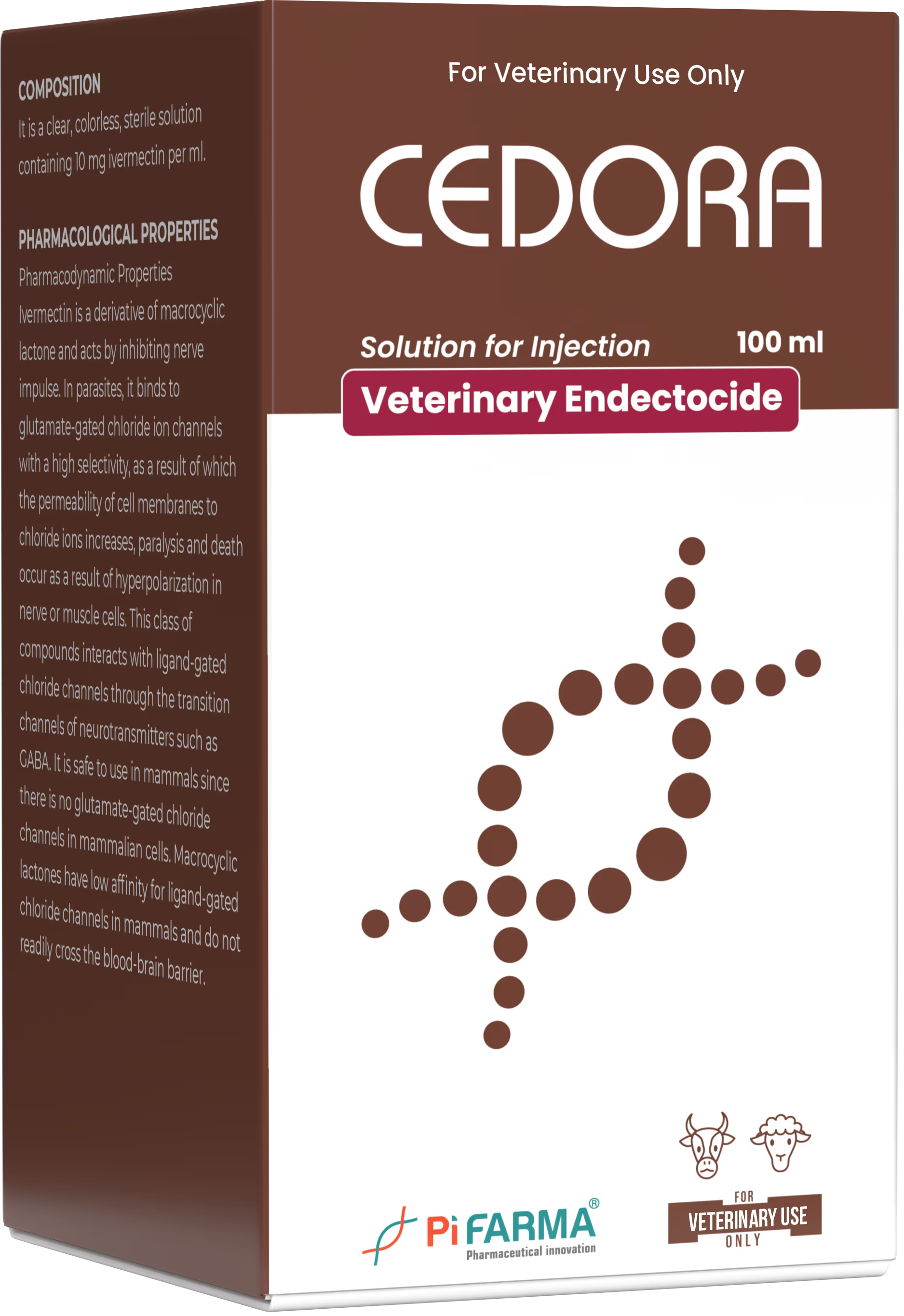
| Product Group | : | Parasiticides |
| Pharmaceutical Form | : | Solution for Injection |
| Active Ingredient | : | Ivermectin |
| Target Species | : | Cattle, Sheep |
| Package Form | : | 100 ml |
For Veterinary Use Only
For Veterinary Use Only
CEDORA
Solution for Injection
Veterinary Endectocide
COMPOSITION
It is a clear, colorless, sterile solution containing 10 mg Ivermectin per ml.
PHARMACOLOGICAL PROPERTIES
Pharmacodynamic Properties
Ivermectin is a derivative of macrocyclic lactone and acts by inhibiting nerve impulse. In parasites, it binds to glutamate-gated chloride ion channels with a high selectivity, as a result of which the permeability of cell membranes to chloride ions increases, paralysis and death occur as a result of hyperpolarization in nerve or muscle cells. This class of compounds interacts with ligand-gated chloride channels through the transition channels of neurotransmitters such as GABA. It is safe to use in mammals since there is no glutamate-gated chloride channels in mammalian cells. Macrocyclic lactones have low affinity for ligand-gated chloride channels in mammals and do not readily cross the blood-brain barrier.
Pharmacokinetic Properties
It reaches peak plasma level (Cmax: 51 ng/ml) in 43 hours following administration in cattle, and its half-life is 129 hours (AUC: 7398 ng h/ml).
It reaches peak plasma level (Cmax: 14 ng/ml) in 202 hours following administration in sheep, and its half-life is 380 hours (AUC: 4686 ng h/ml).
Only 2% of ivermectin is excreted in the urine, the main route of excretion is feces. After the administration, its highest level is in the liver and adipose tissue, and the least level in the brain.
The reason of residual antiparasitic effect in cattle is that its long half-life and 90% protein binding.
AREA OF USE / INDICATIONS
Cattle: It is used for the treatment of internal and external parasites given below.
Gastrointestinal nematods:
Ostertagia ostertagi (adult; L3 larvae; L4 larvae, including hypobiosis)
Ostertagia lyrata (adult and L4 larvae)
Haemonchus placei (adult; L3 and L4 larvae)
Trichostrongylus spp. (adult, L4 larvae)
Cooperia spp. (adult and L4 larvae)
Oesophagostomum radiatum (adult; L3 and L4 larvae)
Nematodirus spp. (adult)
Bunostomum phlebotomum (adult; larvae L3 and L4)
Strongyloides papillosus (adult)
Trichuris spp.(adult)
Toxocara vitulorum (adult)
Lungworm nematods (adult and 4. stage larvae):
Dictyocaulus viviparus
Subcutaneous nematod:
Parafilaria Bovicola (adult)
Eye nematod:
Thelazia spp. (adult)
Warble fly (larval stage):
Hypoderma bovis
H. lineatum
Dermatobia hominis
Chrysomya bezziana
Mange:
Psoroptes ovis
Sarcoptes scabiei var. bovis
Chorioptes bovis
Lice:
Linognathus vituli
Haematopinus eurysternus
Solenopotes capillatus
Ticks:
Ornithodoros savignyi
Boophilus microplus
Boophilus decoloratus
Ivermectin can be used for control Damalinia bovis and Chorioptes bovis, but complete elimination may not be possible. Use of this product at the recommended dose can prevent re-infection for 14 days for Haemonchus placei, Cooperia oncophora, Cooperia pectinata and Trichostrongylus axei, 21 days for Ostertagia ostertagi and Oesophagostomum radiatum, and 28 days for Dictyocaulus viviparus.
Timing of treatment may vary according to epidemiological factors and characteristics of the business. The application program should be evaluated by the veterinarian.
For consistently effect, it is recommended to apply in the pasture animals at the 3rd, 8th and 13th weeks after the pasture, and to treat all the animals.
Sheep: It is used for the treatment of the internal and external parasites given below.
- Gastrointestinal nematods:
Haemonchus contortus (adult, L3 larvae (including hypobiosis) and L4 larvae)
Teladorsagia (Ostertagia) circumcincta (adult, larvae L3 (including hypobiosis) and larvae L4)
Teladorsagia (Ostertagia) trifurcata (adult and larvae L4)
Trichostrongylus axei (adult)
Trichostrongylus colubriformis (adult, larvae L3 and L4)
Trichostrongylus vitrinus (adult)
Cooperia curticei (adult and larvae L4)
Oesophagostomum columbianum (adult, L3 and L4 larvae)
Oesophagostomum venulosum (adult)
Nematodirus filicollis (adult and L4 larvae)
Nematodirus spathiger (adult, L3 and L4 larvae)
Strongyloides papillosus (adult, L3 and L4 larvae)
Trichuris ovis (adult)
Chabertia ovina (adult, L3 and L4 larvae)
Lungworm nematods :
Dictyocaulus filaria (adult and L4 larvae)
Protostrongylus refescens (adult)
Mite:
Psoroptes ovis
Sarcoptes scabiei
Nose nematods:
Oestrus ovis (all larval stages)
Lite
Melophagus ovinus
USAGE AND DOSAGE
It is administered as a single dose, except for Psoroptes ovis treatment.
For correct dosage, the body weight of the animals should be measured as accurately as possible. The accuracy of the dosing device should be controlled.
If herd treatment is applied, animals should be grouped appropriately to avoid over or under dose. Application to wet or dirty animals is not recommended.
Cattle:
Dosage: 1 ml/50 kg body weight (200 µg/kg ivermectin body weight)
Application: It is applied subcutaneously to the front or back of the shoulder area, in accordance with the aseptic technique. It is recommended to use sterile, 1.4 x 15 mm (17G x ½ inch) needle.
Sheep:
Dosage: 0,5 ml/ 25 kg body weight (200 µg ivermektin /kg body weight)
Application: A single injection is applied, following aseptic precautions for gastrointestinal nematodes, lungworms and nasal nematode. It is recommended to use sterile, 1.4 x 15 mm (17G x ½ inch) needle.
Two doses are administered with an interval of 7 days for the treatment of Psoroptes ovis. Injections should be made in a different area.
0.10 ml product is applied for every 5 kg body weight for lambs weighing less than 20 kg. Syringes capable of delivering 0.10 ml of product are recommended for these animals.
SPECIAL CLINICAL INFORMATION AND SPECIAL WARNINGS FOR TARGET SPECIES
The following practices should be avoided because of the risk of resistance development and thus treatment failure.
- Very frequent and repeated use of the same group of anthelmintics within a certain period of time,
- Administering less than the required dose due to miscalculation of body weight, incorrect application of the product, or the delivery device being out of calibration resulting in the application of the wrong amount of product.
In case of the resistance to anthelmintics is suspected, further investigations with appropriate tests should be performed (such as the fecal egg count reduction test (FECRT)). If data show that resistance to a particular anthelmintic has developed, another product with a different pharmacological class and mode of action should be used.
Resistance to macrocyclic lactones including ivermectin has been reported in Teladorsagia in sheep, Ostertagia circumcinta in lambs, Ostertagia ostertagi and Cooperia in cattle. Therefore, this product should be used based on regional (farm or wider) epidemiological susceptibility data.
Even if clinical improvement is observed, a single dose is not recommended for the treatment of pseudoptic mange in sheep because not all agents can be eliminated. Psotoptis ovis is a highly contagious external parasite. After treatment, due care should be taken to avoid re-infestation of treated animals, as agents can survive for an additional 15 days. It is important to treat all animals in contact with infected sheep. Contact between treated animals and non-treated animals should be avoided for at least 7 days after the last treatment.
Because ivermectin is highly bound to plasma proteins, it should be used with caution in animals with diseases or nutritional deficiencies with low plasma protein levels.
Avermectins may not be well tolerated in non-target species. Fatal cases of intolerance have been reported in dogs, particularly Collies, Bobtails, Old English Sheepdogs, and close or cross breeds, as well as turtles.
Do not combine with lungworm vaccines. If the product is to be administered to vaccinated animals, it should be administered 28 days before or after vaccination.
Excretion of nematode eggs may continue for some time after treatment.
In cattle, it is recommended to apply the product in the final stage of warble flies, before they reach these areas, in order to avoid secondary reactions caused by the death of Hypoderma larvae in the esophagus and spine. The death of the Hypoderma lineatum in the peri-esophageal tissue can cause salivation and tympania. Death of Hypoderma bovis while in the spinal canal can cause paresis or paralysis.
Clean the vial before each use.
Use in pregnancy and lactation: This product can be used in pregnant cattle and sheep. The product has no adverse effects on fertility.
ADVERSE EFFECTS
Discomfort may observe in some animals after subcutaneous administration. In cattle, this situation manifests itself in the form of jumping and rolling. Behaviors usually return to normal within 15 minutes of administration. Solidification and swelling may occur at the injection site. These reactions are temporary and disappear within 1-4 weeks.
Allergic and anaphylactic reactions may occur very rarely. These reactions may also be accompanied by nervous symptoms such as ataxia, convulsions and/or tremor.
DRUG INTERACTIONS
Do not combine with lungworm vaccines. If the product is administered to vaccinated animals, it should be administered 28 days before or after vaccination.
Do not mix with the other medicinal products.
SYMPTOMS OF OVERDOSE, PRECAUTIONS AND ANTIDOTE
Clinical symptoms of ivermectin toxicity in cattle are ataxia and depression (20 times the recommended dose). There is no antidote. In case of overdose, symptomatic treatment should be applied. No indication of toxicity was observed in applications up to 3 times the recommended dose. At 100 times the recommended dose, ataxia, bilateral mydriasis, dyspnea and somnolence were observed in pigs, which did not result in death.
Overdose in sheep can cause ataxia and depression. No systemic toxic effects were observed at twice the recommended dose. In case of overdose, symptomatic treatment can be applied.
WITHDRAWAL PERIODS
Meat: 49 days for cattle, 42 days for sheep. Do not use in cattle and sheep producing milk for human consumption. It is not used within 60 days before birth in pregnant cows and sheep whose milk will be offered for human consumption.
CONTRAINDICATIONS
Do not use intravenously and intramuscularly.
Do not use in animals known to be sensitive to the components.
Do not use in cats and dogs due to possible serious side effects
GENERAL WARNINGS
Consult your veterinarian before use and in case of unexpected effects.
Keep out of reach of children.
PRECAUTIONS TO BE TAKEN BY THE ADMINISTRATOR AND WARNINGS FOR VETERINARY SURGEON
Do not consume anything, including cigarettes, while applying the product. Wash hands after use. Take necessary precautions to prevent accidental injection as it causes irritation and pain at the injection site. In case of accidental self-injection, consult a doctor with the product label and leaflet. Do not contact the product. In case of contact, wash the area with plenty of soap and water. In case of contact with eyes, rinse with plenty of running water.
STORAGE CONDITIONS AND SHELF LIFE
Before and after opening, it should be stored under 25ᵒC, in the original packages, without freezing and refrigerating. Protect from sunlight. Shelf life is 2 years. It should be consumed within 28 days, after opening. The product cap can be punctured up to 30 times.
DISPOSAL AFTER USE AND WARNINGS FOR NON-TARGET SPECIES
HIGHLY TOXIC TO FISH AND AQUATIC LIFE. The product or used product containers should never be disposed of in or near water sources.
The product is highly toxic to aquatic organisms and dung beetles. Cattle must not have direct access to ponds, streams or ditches within 14 days of treatment. Long-term effects on dung beetles cannot be neglected due to continuous or repeated use. Therefore, repeating treatments on a pasture during a seasonal period should only be done on the advice of a veterinarian.
Used or leftover product should be disposed of in accordance with the relevant legislation.
COMMERCIAL PRESENTATION FORM
In a cardboard box containing a 20 mm gray bromobutyl stopper and printed flip-off colorless caps on 100 ml Type II colorless glass bottles.
PLACE AND CONDITIONS OF SALE
Sold with Veterinary Surgeon’s prescription in pharmacies and veterinary surgeries.
APPROVAL DATE OF LEAFLET: 28.04.2025
MARKETING AUTHORIZATION DATE AND NO: 27.04.2001 – 010/0943
MARKETING AUTHORIZATION HOLDER
Pİ FARMA İLAÇ SAN. VE TİC. A.Ş.
Malıköy Başkent OSB Mah. 26. Cad. No:34/A Sincan/Ankara-Türkiye
MANUFACTURER COMPANY
FDN İLAÇ SAN. VE TİC. LTD. ŞTİ.
Büyükkayacık OSB Mah. İnsu Sokak No:3 Selçuklu/Konya-Türkiye
Made in Turkiye